CollaQ
Overview
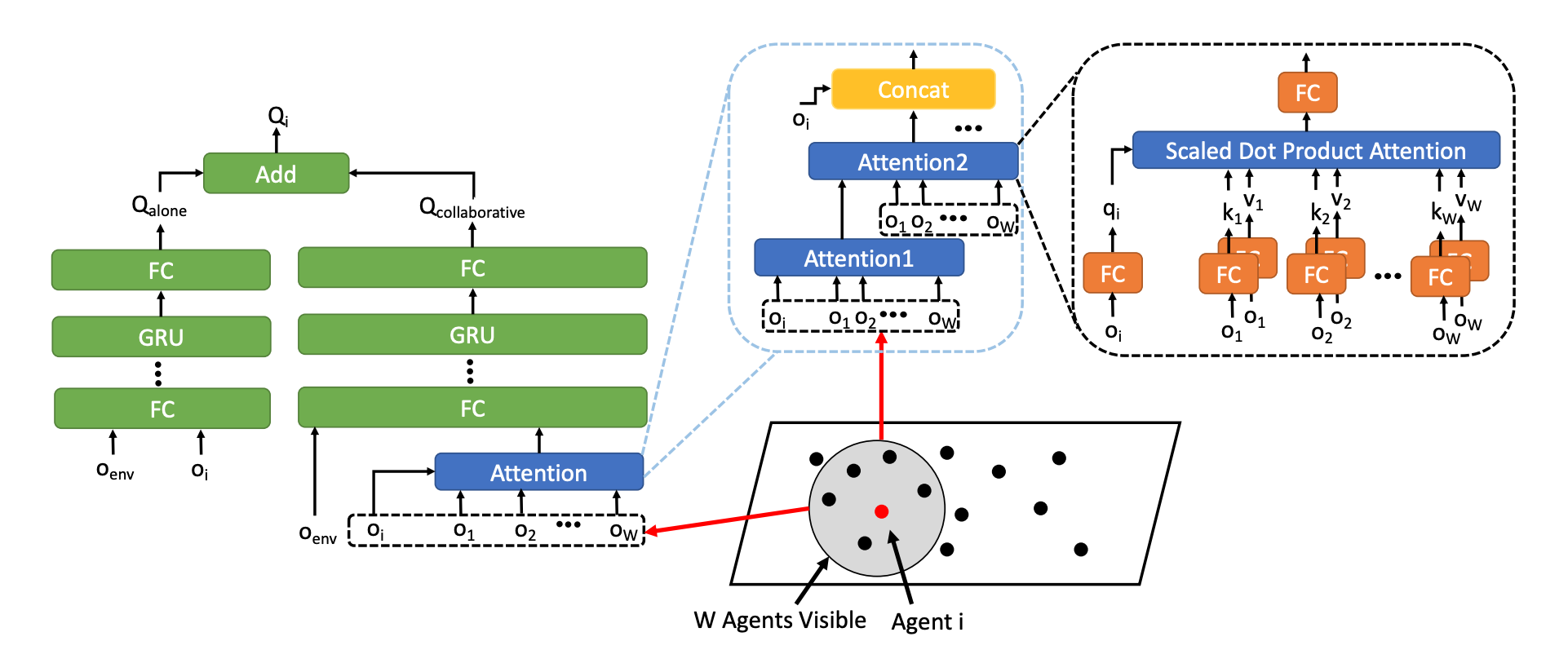
CollaQ (Zhang et al. 2020), Collaborative Q-learning, is a multi-agent collaboration approach based on Q-learning, which formulates multi-agent collaboration as a joint optimization problem on reward assignment. CollaQ decomposes decentralized Q value functions of individual agents into two terms, the self-term that only relies on the agent’s own state, and the interactive term that is related to states of nearby agents. CollaQ jointly trains using regular DQN, regulated with a Multi-Agent Reward Attribution (MARA) loss.
Quick Facts
CollaQ is a model-free and value-based multi-agent RL approach.
CollaQ only supports discrete action spaces.
CollaQ is an off-policy algorithm.
CollaQ considers a partially observable scenario in which each agent only obtains individual observations.
CollaQ uses DRQN architecture for individual Q learning.
Compared to QMIX and VDN, CollaQ doesn’t need a centralized Q function, which expands the individual Q-function for each agent with reward assignment depending on the joint state.
Key Equations or Key Graphs
The overall architecture of the Q-function with attention-based model in CollaQ:
The Q-function for agent i:
The overall training objective of standard DQN training with MARA loss:
Extensions
CollaQ can choose to use an attention-based architecture or not. Because the observation can be spatially large and covers agents whose states do not contribute much to a certain agent policy. In details, CollaQ uses a transformer architecture (stacking multiple layers of attention modules), which empirically helps improve the performance in multi-agent tasks.
Implementations
The default config is defined as follows:
- class ding.policy.collaq.CollaQPolicy(cfg: dict, model: Optional[Union[type, torch.nn.modules.module.Module]] = None, enable_field: Optional[List[str]] = None)[source]
- Overview:
Policy class of CollaQ algorithm. CollaQ is a multi-agent reinforcement learning algorithm
- Interface:
- _init_learn, _data_preprocess_learn, _forward_learn, _reset_learn, _state_dict_learn, _load_state_dict_learn
_init_collect, _forward_collect, _reset_collect, _process_transition, _init_eval, _forward_eval_reset_eval, _get_train_sample, default_model
- Config:
ID
Symbol
Type
Default Value
Description
Other(Shape)
1
typestr
collaq
POLICY_REGISTRY2
cudabool
True
3
on_policybool
False
prioritybool
False
5
priority_IS_weightbool
False
6
learn.update_per_collectint
20
7
learn.target_update_thetafloat
0.001
8
learn.discount_factorfloat
0.99
9
learn.collaq_loss_weightfloat
1.0
The network interface CollaQ used is defined as follows:
- class ding.model.template.qmix.CollaQ(agent_num: int, obs_shape: int, alone_obs_shape: int, global_obs_shape: int, action_shape: int, hidden_size_list: list, attention: bool = False, self_feature_range: Optional[List[int]] = None, ally_feature_range: Optional[List[int]] = None, attention_size: int = 32, mixer: bool = True, lstm_type: str = 'gru', dueling: bool = False, use_pmixer: bool = False)[source]
- Overview:
CollaQ network
- Interface:
__init__, forward, _setup_global_encoder
- __init__(agent_num: int, obs_shape: int, alone_obs_shape: int, global_obs_shape: int, action_shape: int, hidden_size_list: list, attention: bool = False, self_feature_range: Optional[List[int]] = None, ally_feature_range: Optional[List[int]] = None, attention_size: int = 32, mixer: bool = True, lstm_type: str = 'gru', dueling: bool = False, use_pmixer: bool = False) → None[source]
- Overview:
initialize Collaq network
- Arguments:
agent_num (
int): the number of agentobs_shape (
int): the dimension of each agent’s observation statealone_obs_shape (
int): the dimension of each agent’s observation state without other agentsglobal_obs_shape (
int): the dimension of global observation stateaction_shape (
int): the dimension of action shapehidden_size_list (
list): the list of hidden sizeattention (
bool): use attention module or not, default to Falseself_feature_range (
Union[List[int], None]): the agent’s feature rangeally_feature_range (
Union[List[int], None]): the agent ally’s feature rangeattention_size (
int): the size of attention net layermixer (
bool): use mixer net or not, default to True
- forward(data: dict, single_step: bool = True) → dict[source]
- Overview:
forward computation graph of collaQ network
- Arguments:
- data (
dict): input data dict with keys [‘obs’, ‘prev_state’, ‘action’]
agent_state (
torch.Tensor): each agent local state(obs)agent_alone_state (
torch.Tensor): each agent’s local state alone, in smac setting is without ally feature(obs_along)global_state (
torch.Tensor): global state(obs)prev_state (
list): previous rnn state, should include 3 parts: one hidden state of q_network, and two hidden state if q_alone_network for obs and obs_alone inputsaction (
torch.Tensoror None): if action is None, use argmax q_value index as action to calculateagent_q_actsingle_step (
bool): whether single_step forward, if so, add timestep dim before forward and remove it after forward- Return:
- ret (
dict): output data dict with keys [‘total_q’, ‘logit’, ‘next_state’]
total_q (
torch.Tensor): total q_value, which is the result of mixer networkagent_q (
torch.Tensor): each agent q_valuenext_state (
list): next rnn state- Shapes:
agent_state (
torch.Tensor): \((T, B, A, N)\), where T is timestep, B is batch_size A is agent_num, N is obs_shapeglobal_state (
torch.Tensor): \((T, B, M)\), where M is global_obs_shapeprev_state (
list): math:(B, A), a list of length B, and each element is a list of length Aaction (
torch.Tensor): \((T, B, A)\)total_q (
torch.Tensor): \((T, B)\)agent_q (
torch.Tensor): \((T, B, A, P)\), where P is action_shapenext_state (
list): math:(B, A), a list of length B, and each element is a list of length A
The Benchmark result of CollaQ in SMAC (Samvelyan et al. 2019), for StarCraft micromanagement problems, implemented in DI-engine is shown.
References
Tianjun Zhang, Huazhe Xu, Xiaolong Wang, Yi Wu, Kurt Keutzer, Joseph E. Gonzalez, Yuandong Tian. Multi-Agent Collaboration via Reward Attribution Decomposition. arXiv preprint arXiv:2010.08531, 2020.
Mikayel Samvelyan, Tabish Rashid, Christian Schroeder de Witt, Gregory Farquhar, Nantas Nardelli, Tim G. J. Rudner, Chia-Man Hung, Philip H. S. Torr, Jakob Foerster, Shimon Whiteson. The StarCraft Multi-Agent Challenge. arXiv preprint arXiv:1902.04043, 2019.