QMIX
Overview
QMIX is proposed by Rashid et al.(2018) for learning joint action values conditioned on extra state information in multi-agent centralized learning, which trains decentralized policies in a centralized end-to-end framework. QMIX employs a centralized neural network to estimate joint action values as a complex non-linear combination of per-agent action values based on local observations. QMIX provides a novel presentation of centralized action-value functions and guarantees consistency between the centralized and decentralized policies.
QMIX is a non-linear extension of VDN (Sunehag et al. 2017). Compared to VDN, QMIX can represent more extra state information during training and a much richer class of action-value functions.
Quick Facts
QMIX uses the paradigm of centralized training with decentralized execution.
QMIX is a model-free and value-based method.
QMIX only support discrete action spaces.
QMIX is an off-policy multi-agent RL algorithm.
QMIX considers a partially observable scenario in which each agent only obtains individual observations.
QMIX accepts DRQN as individual value network.
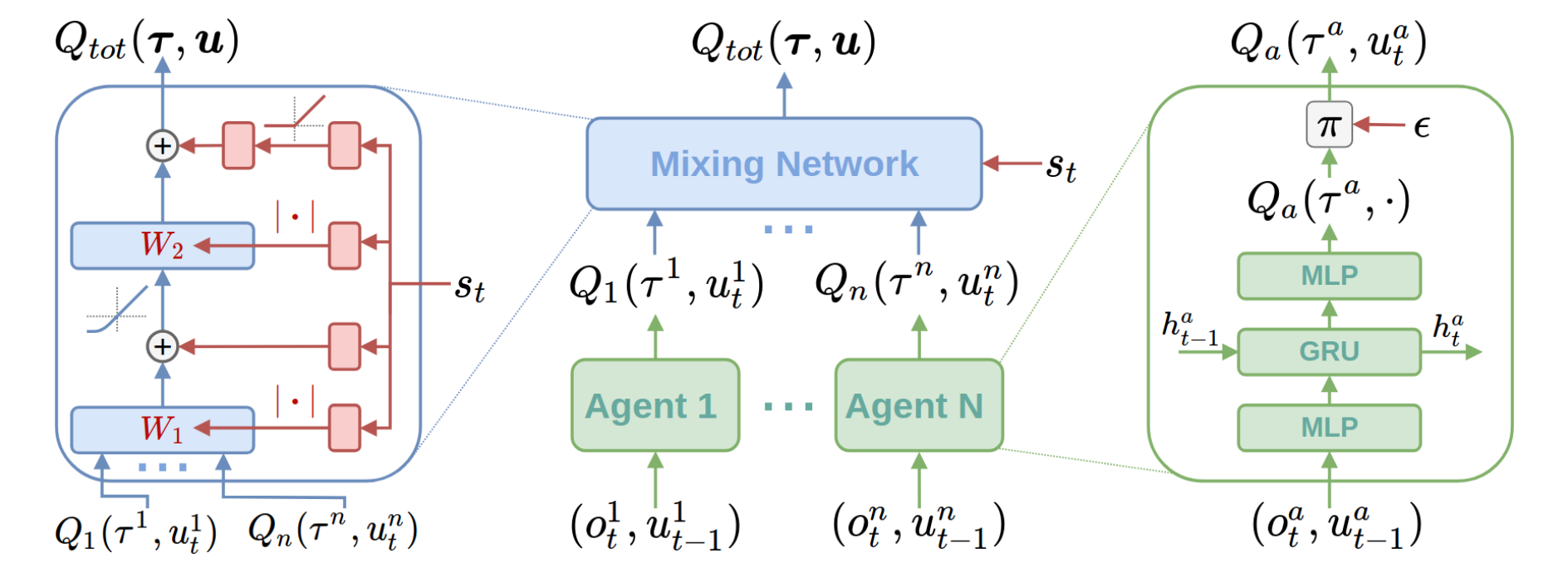
QMIX represents the joint value function using an architecture consisting of agent networks, a mixing network. The mixing network is a feed-forward neural network that takes the agent network outputs as input and mixes them monotonically, producing joint action values.
Key Equations or Key Graphs
The overall QMIX architecture including individual agent networks and the mixing network structure:
QMIX trains the mixing network via minimizing the following loss:
Each weight of the mixing network is produced by a independent hyper-network, which takes the global state as input and outputs the weight of one layer of the mixing network. More implemented details can be found in the origin paper.
Extensions
VDN and QMIX are representative methods that use the idea of factorization of the joint action-value function \(Q_{tot}\) into individual ones \(Q_a\) for decentralized execution. These value factorization techniques suffer structural constraints, such as additive decomposability in VDN and monotonicity in QMIX.
VDN factorizes the joint action-value function into a sum of individual action-value functions. For consistency it need to ensure that a global \(argmax\) performed on \(Q_{tot}\) yields the same result as a set of individual \(argmax\) operations performed on each \(Q_a\):
QMIX extends this additive value factorization to represent the joint action-value function as a monotonic function. QMIX is based on monotonicity, a constraint on the relationship between joint action values \(Q_{tot}\) and individual action values \(Q_a\).
QTRAN (Son et al. 2019), as an extension of QMIX, proposes a factorization method, which is free from such structural constraints via transforming the original joint action-value function into an easily factorizable one. QTRAN guarantees more general factorization than VDN or QMIX.
Implementations
The default config is defined as follows:
- class ding.policy.qmix.QMIXPolicy(cfg: dict, model: Optional[Union[type, torch.nn.modules.module.Module]] = None, enable_field: Optional[List[str]] = None)[source]
- Overview:
- Policy class of QMIX algorithm. QMIX is a multi model reinforcement learning algorithm,
you can view the paper in the following link https://arxiv.org/abs/1803.11485
- Interface:
- _init_learn, _data_preprocess_learn, _forward_learn, _reset_learn, _state_dict_learn, _load_state_dict_learn
_init_collect, _forward_collect, _reset_collect, _process_transition, _init_eval, _forward_eval_reset_eval, _get_train_sample, default_model
- Config:
ID
Symbol
Type
Default Value
Description
Other(Shape)
1
typestr
qmix
POLICY_REGISTRY2
cudabool
True
3
on_policybool
False
prioritybool
False
5
priority_IS_weightbool
False
6
learn.update_per_collectint
20
7
learn.target_update_thetafloat
0.001
8
learn.discount_factorfloat
0.99
- The network interface QMIX used is defined as follows:
- class ding.model.template.QMix(agent_num: int, obs_shape: int, global_obs_shape: int, action_shape: int, hidden_size_list: list, mixer: bool = True, lstm_type: str = 'gru', dueling: bool = False)[source]
- Overview:
QMIX network
- Interface:
__init__, forward, _setup_global_encoder
- __init__(agent_num: int, obs_shape: int, global_obs_shape: int, action_shape: int, hidden_size_list: list, mixer: bool = True, lstm_type: str = 'gru', dueling: bool = False) → None[source]
- Overview:
initialize Qmix network
- Arguments:
agent_num (
int): the number of agentobs_shape (
int): the dimension of each agent’s observation stateglobal_obs_shape (
int): the dimension of global observation stateaction_shape (
int): the dimension of action shapehidden_size_list (
list): the list of hidden sizemixer (
bool): use mixer net or not, default to Trueuse_gru (
bool): use lstm type or not, default to Falseuse_pmixer (
bool): use pymarl mixer net or not, default to False. When mixer is False, we can’t use pymarl mixer net or normal mixer net
- forward(data: dict, single_step: bool = True) → dict[source]
- Overview:
forward computation graph of qmix network
- Arguments:
- data (
dict): input data dict with keys [‘obs’, ‘prev_state’, ‘action’] agent_state (
torch.Tensor): each agent local state(obs)global_state (
torch.Tensor): global state(obs)prev_state (
list): previous rnn stateaction (
torch.Tensoror None): if action is None, use argmax q_value index as action to calculateagent_q_act
- data (
single_step (
bool): whether single_step forward, if so, add timestep dim before forward and remove it after forward
- Returns:
ret (
dict): output data dict with keys [total_q,logit,next_state]total_q (
torch.Tensor): total q_value, which is the result of mixer networkagent_q (
torch.Tensor): each agent q_valuenext_state (
list): next rnn state
- Shapes:
agent_state (
torch.Tensor): \((T, B, A, N)\), where T is timestep, B is batch_size A is agent_num, N is obs_shapeglobal_state (
torch.Tensor): \((T, B, M)\), where M is global_obs_shapeprev_state (
list): math:(B, A), a list of length B, and each element is a list of length Aaction (
torch.Tensor): \((T, B, A)\)total_q (
torch.Tensor): \((T, B)\)agent_q (
torch.Tensor): \((T, B, A, P)\), where P is action_shapenext_state (
list): math:(B, A), a list of length B, and each element is a list of length A
The Benchmark result of QMIX in SMAC (Samvelyan et al. 2019), for StarCraft micromanagement problems, implemented in DI-engine is shown.
References
Tabish Rashid, Mikayel Samvelyan, Christian Schroeder de Witt, Gregory Farquhar, Jakob Foerster, Shimon Whiteson. Qmix: Monotonic value function factorisation for deep multi-agent reinforcement learning. International Conference on Machine Learning. PMLR, 2018.
Peter Sunehag, Guy Lever, Audrunas Gruslys, Wojciech Marian Czarnecki, Vinicius Zambaldi, Max Jaderberg, Marc Lanctot, Nicolas Sonnerat, Joel Z. Leibo, Karl Tuyls, Thore Graepel. Value-decomposition networks for cooperative multi-agent learning. arXiv preprint arXiv:1706.05296, 2017.
Kyunghwan Son, Daewoo Kim, Wan Ju Kang, David Earl Hostallero, Yung Yi. QTRAN: Learning to Factorize with Transformation for Cooperative Multi-Agent Reinforcement Learning. International Conference on Machine Learning. PMLR, 2019.
Mikayel Samvelyan, Tabish Rashid, Christian Schroeder de Witt, Gregory Farquhar, Nantas Nardelli, Tim G. J. Rudner, Chia-Man Hung, Philip H. S. Torr, Jakob Foerster, Shimon Whiteson. The StarCraft Multi-Agent Challenge. arXiv preprint arXiv:1902.04043, 2019.